
Home / Piston pumps
Pumps · Piston pumps
Variable flow, shaped by a regulator.
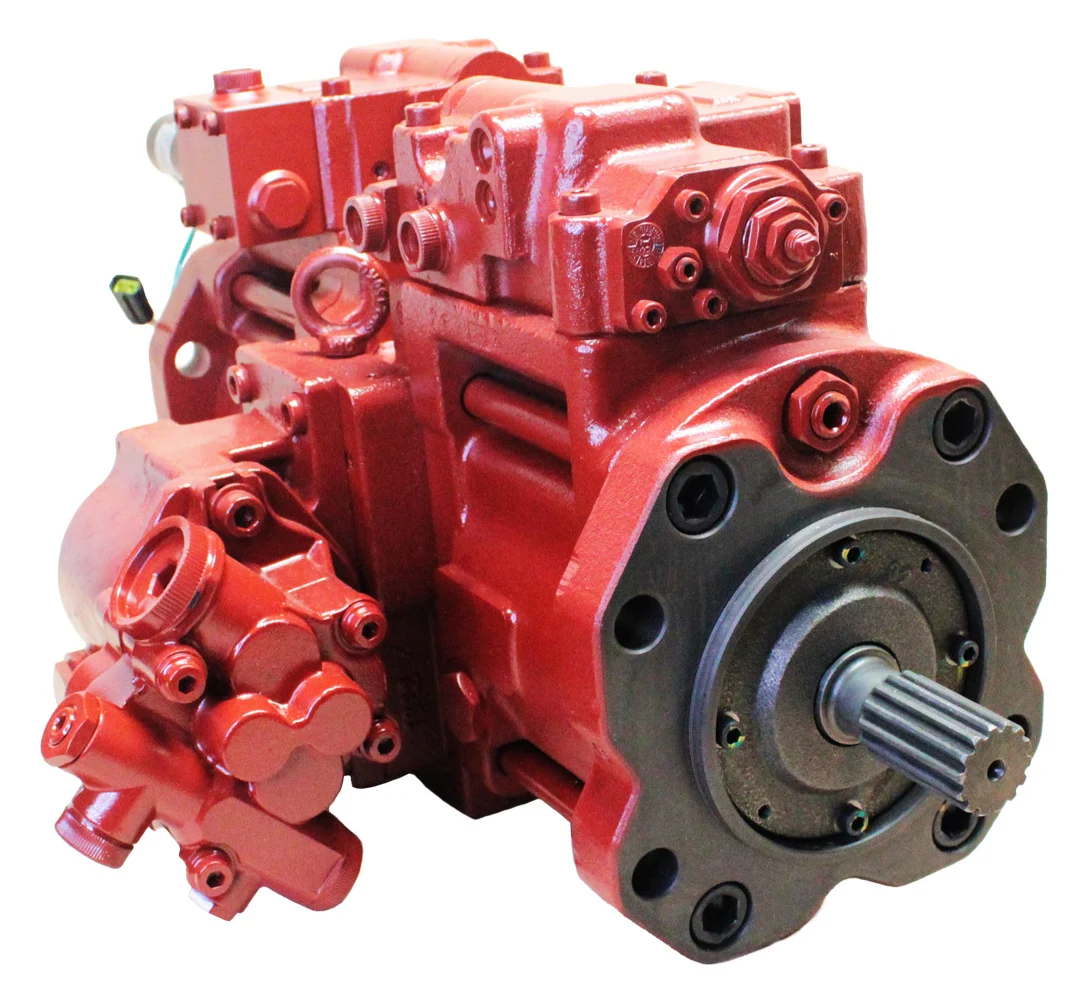
An axial piston pump moves pistons in and out as the cylinder block turns. With a swashplate the displacement can change, which is why these pumps feed the main circuits of many excavators.
Hydraulic Atlas
Anatomy of an axial piston pump
A section through a swashplate pump with a regulator. Select a numbered marker or a part in the list.
Atlas · Piston pumps
Axial piston pump with a swashplate
An original section of a variable-displacement swashplate pump. The swashplate angle sets the piston stroke, and so the displacement.
Schematic How this family is built
Swipe the drawing sideways to see all of it. The list below has the same descriptions.
Select a numbered marker on the drawing or a part in the list to see what it is, and what it does.
All 14 parts
-
Turns the cylinder block. Splined or keyed; diameter and spline count are identification data. A through-drive version has a second shaft end for a following pump.
-
Seals the shaft in the housing flange against case oil. It sees case pressure, which is one reason the case drain line matters.
-
Holds the rotating group and the swashplate and is filled with case oil that cools and lubricates. The mounting flange sits here.
-
The tilted plate the slippers slide on. A larger tilt gives a longer piston stroke and larger displacement; at zero tilt there is no stroke and no flow. It rides on saddle bearings.
-
Ball-jointed shoes on the piston ends. They slide on the swashplate on a thin oil film.
-
Move in and out of the cylinder block bores. Moving out they draw oil in; moving in they push it out.
-
Splined to the shaft and rotating with it. Its bores hold the pistons and run on the valve plate.
-
The fixed plate the block slides on. Its kidney-shaped slots connect each bore to the inlet or the outlet as the block turns. Rotation direction can set the valve plate version (left or right hand).
-
Closes the pump at the rear and carries the inlet and outlet passages. Rear or side ports, and the through-drive flange, are variants.
-
Inlet at low pressure, outlet at working pressure. Thread or flange type, size and position are identification data.
-
Carry the shaft at the flange and at the rear.
-
Variable-displacement pumps
Moves the swashplate against a bias spring when the regulator sends it pressure. This is how displacement changes.
-
Where fitted
Controls the swashplate angle: pressure, power or load-sensing (LS) type. The regulator limits what the pump does with the flow; it does not create pressure.
-
Holds the slippers against the swashplate so the pistons follow it, including on the suction stroke.
Data that identifies a piston pump
Most of it is on the pump, in the machine documentation, or can be measured.
- nameplate, photographed in full
- displacement in cm³/rev
- direction of rotation, viewed from the shaft end by the manufacturer’s reference point
- shaft: splined or keyed, diameter, number of splines
- flange and bolt pattern
- ports: type, size and position
- regulator type and a photo of it
- machine make, model and year
Displacement
Fixed and variable displacement
In a fixed-displacement pump the design sets the volume per revolution. In a variable-displacement swashplate pump the regulator changes the swashplate angle, so the volume per revolution moves between zero and its maximum. The pressure still comes from the load.
Bent-axis pumps follow the same principle with the cylinder block set at an angle to the shaft.
Principle
Pistons, swashplate, stroke
Pistons sit in a rotating cylinder block. A tilted swashplate makes them stroke: they draw oil in while moving out and push it out while moving in. A larger tilt gives a larger stroke and more flow per revolution. Move the control to change the swashplate angle.
Pump type
Relative displacement (an example, not an FEK parameter):
Unrolled view of an axial piston pump: pistons in a rotating barrel slide over a stationary swashplate. Moving out, they draw oil in; moving in, they push it to the port. The larger the plate angle, the longer the stroke and the larger the displacement.
Change the angle with the slider and watch the piston stroke grow. Switch the pump type to compare with a gear pump.
Flow ≈ displacement × speed: at constant speed it grows with plate angle. Pressure comes from the load, not the pump.
Regulators
What the regulator does with the flow
Pressure
Reduces displacement when the set pressure is reached, so the pump does not push more flow than the system takes.
Power
Limits the share of engine power the pump takes by trading flow against pressure.
LS (load sensing)
A control signal that tells the regulator how much flow the circuit asks for. It is not the main power line.
Work on a hydraulic system only as the machine manufacturer instructs, and only after the pressure has been released safely. Regulator settings come from the machine manufacturer’s instructions.
Selection
Data needed to select a piston pump
To read
- marking or part number on the nameplate
- displacement (cm³/rev)
- direction of rotation, viewed from the shaft end
- single- or multi-section unit
To measure or photograph
- shaft: splined or keyed, diameter, number of splines
- flange and bolt pattern
- ports: type, size, position
- regulator type and any solenoid
- case drain port
- machine make, model and year
The regulator, shaft and flange decide the fit. FEK confirms the match from the data.
Next